Which Birds Visit Indian Balconies? A Complete Identification Guide for Urban Bird Lovers
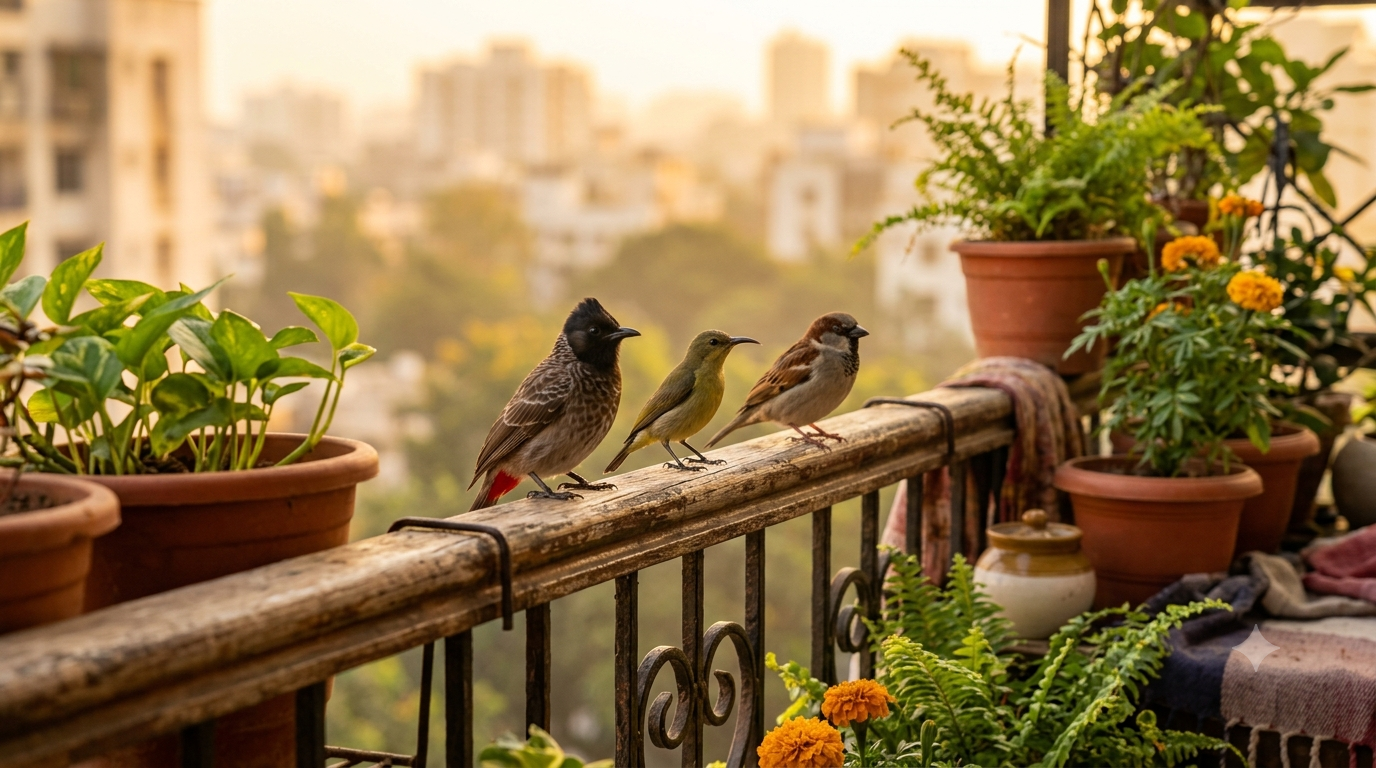
Something stirs outside your window, a flash of scarlet, a cheerful chirp, or a tiny creature perched boldly on your railing. If you have ever wondered which birds visit Indian balconies and how you can tell them apart, this guide is for you. From the iconic house sparrow to the jewel-like purple sunbird, Indian cities host a surprisingly rich cast of feathered visitors and identifying them is easier than you think.
TABLE OF CONTENTS:
Why birds visit urban balconies in India
How to identify a bird: 4 quick clues
10 common birds on Indian balconies (with ID tips)
Quick identification table at a glance
Which birds come in which season?
How to attract more birds to your balcony
Frequently asked questions
Why Birds Visit Urban Balconies in India
India is one of the world's great bird nations, home to over 1,300 recorded species. Even in dense urban centres like Mumbai, Delhi, Bengaluru, or Hyderabad, dozens of bird species adapt remarkably well to city life and your balcony, terrace, or windowsill can become a genuine refuge for them.
Birds are drawn to balconies for three primary reasons: food, water, and safe shelter. A simple grain feeder, a shallow clay water bowl, and a wooden nest box can transform even a 5th-floor apartment balcony into a thriving urban bird habitat. Understanding which species you are seeing is the first step to welcoming them back.
"In every walk with nature one receives far more than one seeks and nowhere is that more true than on a quiet Indian morning with birdsong drifting over the rooftops."
Inspired by John Muir, adapted for urban birdwatchers
How to Identify a Bird: 4 Quick Clues
You do not need a professional ornithologist's training to identify the birds visiting your balcony. Focus on these four things:
- Size: Is it smaller than a sparrow, sparrow-sized, pigeon-sized, or larger?
- Colour and markings: Note the head, chest, wings, and tail. Even a quick impression helps narrow it down significantly.
- Call: Every bird has a distinct voice. A melodious warble, a harsh squawk, a short chip, these are often the fastest identification clue.
- Behaviour: Does it hop, climb tree trunks, dart in mid-air, or sit bolt upright? Behaviour is surprisingly species-specific
Keep a small notebook or use your phone's camera. Even a blurry photo captures colour and size, which is often enough for a confident ID.
10 Common Birds on Indian Balconies (With Full Identification Tips)
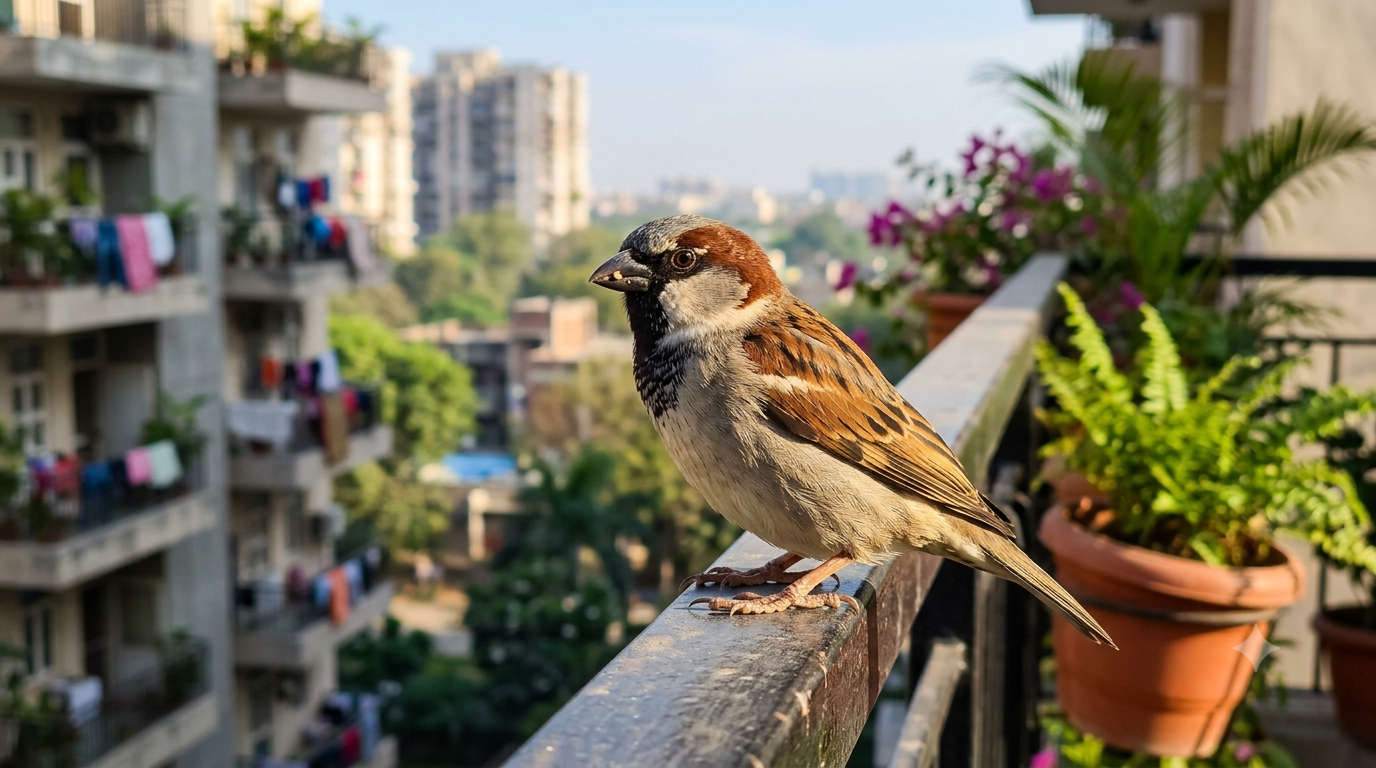
The following birds are the most frequently spotted on balconies, terraces, and windowsills across Indian cities. Each entry includes key identification details so you can spot them confidently.
1. House Sparrow
Scientific name: Passer domesticus
Size: Small (14 to 16 cm) | Found: Pan-India | Season: Year-round
The house sparrow is India's most beloved balcony bird and sadly one of its most threatened urban species. Males wear a rich chestnut-brown back, a grey crown, and a distinctive black bib at the throat. Females are streaky brown with a pale eyebrow stripe, often mistaken for entirely different species by beginners.
Colour: Brown, grey, black bib (male); streaky brown (female)
Call: Cheerful, repetitive "cheep cheep"
Eats: Bajra, jowar, small insects, rice
Nests in: Cavities, eaves, wooden nest boxes
2. Red-vented Bulbul
Scientific name: Pycnonotus cafer
Size: Medium (20 to 23 cm) | Found: Pan-India | Season: Year-round
The red-vented bulbul is one of India's noisiest and most recognisable urban birds. Its dark brown body, crested black head, and bright red patch under the tail make it almost unmistakable. It is usually the first bird to start calling in the morning and the last to go quiet at dusk. Bulbuls love fruit, so guava, papaya, and berries on a balcony will bring them in reliably.
Colour: Dark brown body, black crest, red vent
Call: Loud, musical phrases that sound like "be careful!"
Eats: Fruits, berries, insects, nectar
Look for: Red under-tail patch, the giveaway
3. Purple Sunbird
Scientific name: Cinnyris asiaticus
Size: Tiny (10 to 11 cm) | Found: Pan-India | Season: Year-round
India's answer to the hummingbird. The male purple sunbird shimmers with an iridescent dark blue-purple coat that changes colour in sunlight, one moment looking black, the next blazing violet-blue. The female is much more subdued, with a yellowish-olive underside, but just as agile. Sunbirds hover briefly at flowers to drink nectar, then dart away in a flash. If you have potted flowering plants on your balcony, sunbirds will find them.
Colour: Iridescent blue-purple (male); yellow-olive (female)
Call: High, thin "tsi-tsi" or rapid chattering
Eats: Flower nectar, small insects
Behaviour: Hovers at flowers; distinctive curved beak
4. Common Myna
Scientific name: Acridotheres tristis
Size: Medium (23 to 26 cm) | Found: Pan-India | Season: Year-round
Bold, loud, and utterly unfazed by humans, the common myna is the quintessential Indian urban bird. It has a brown body, a black head, a bright yellow bill, and unmistakable yellow eye patches. In flight, large white wing patches flash conspicuously. Mynas are famously opportunistic eaters and will confidently walk onto balconies looking for food scraps, insects, and fruit.
Colour: Brown body, black head, yellow bill and eye patch
Call: Loud, varied, chattering, whistles, and mimicry
Eats: Almost anything, insects, fruit, scraps
Look for: White wing patches visible in flight
5. Rock Pigeon (Common Pigeon)
Scientific name: Columba livia
Size: Large (29 to 37 cm) | Found: Pan-India | Season: Year-round
The rock pigeon needs no introduction, it is the most abundant urban bird in India. Typically grey with iridescent green and purple neck feathers and two dark wing bars, though urban populations vary enormously in colour due to centuries of semi-domestication. Often considered a nuisance, pigeons are nonetheless highly intelligent birds. If you want to discourage them while welcoming smaller birds, avoid placing grain directly on flat open surfaces.
Colour: Grey (wild type); highly variable in cities
Call: Deep, repetitive cooing "coo-roo-c'too"
Eats: Grain, seeds, bread, scraps
Nests on: Ledges, AC units, balcony beams
6. Asian Koel
Scientific name: Eudynamys scolopaceus
Size: Medium (39 to 46 cm) | Found: Pan-India | Season: Summer (breeding)
You almost certainly hear the koel before you ever see it. The male's ascending call, a repetitive, insistent "ko-el, ko-el, ko-el" that climbs higher and higher, is one of the defining sounds of an Indian summer. The male is a glossy all-black bird with bright red eyes. The female is very different: heavily streaked brown with white spots, and much harder to spot. Koels visit balconies with fruiting trees nearby and are most vocal from February through June.
Colour: All black with red eye (male); brown-spotted (female)
Call: Rising "ko-EL ko-EL", completely unmistakable
Eats: Fruit, figs, small berries
Note: A brood parasite that lays its eggs in crow nests
7. Spotted Dove
Scientific name: Spilopelia chinensis
Size: Medium (28 to 32 cm) | Found: Pan-India | Season: Year-round
Gentler and more graceful than the rock pigeon, the spotted dove is a delightful balcony visitor. Its key marking is a distinctive black-and-white spotted patch on the back of its neck, like a necklace of tiny dots. The rest of the bird is a warm pinkish-brown. Its soft, three-note cooing "coo-CROO-coo" is a soothing constant in Indian gardens and terraces.
Colour: Pinkish-brown with black-and-white neck patch
Call: Soft three-note "coo-CROO-coo"
Eats: Seeds, grain, small insects
Look for: Spotted necklace on the neck, the key ID mark
8. Oriental Magpie-Robin
Scientific name: Copsychus saularis
Size: Small (19 to 23 cm) | Found: Pan-India | Season: Year-round
One of India's finest songsters. The oriental magpie-robin male is a striking black and white bird, jet black above and white below, with a bold white wing stripe. It perches upright with its tail raised at a jaunty angle, then bursts into a rich, complex song that can go on for several minutes. The female is grey where the male is black. Magpie-robins often visit balconies in older residential areas with mature trees nearby.
Colour: Black and white (male); grey and white (female)
Call: Rich, varied musical song, among India's finest
Eats: Insects, worms, small lizards
Posture: Tail cocked upwards, a distinctive, constant habit
9. House Crow
Scientific name: Corvus splendens
Size: Large (40 to 43 cm) | Found: Pan-India | Season: Year-round
Crows are among the most intelligent birds on the planet, and the house crow is a master of urban life. It has a grey neck and upper chest with a glossy black body, wings, and tail. Crows are notorious for raiding smaller birds' nests, so keeping them away from your birdhouse is important. They respond well to deterrents like metal guards and properly sized entry holes under 32 mm that physically exclude them.
Colour: Grey collar and neck with black body
Call: Harsh, nasal "kaa kaa"
Eats: Omnivore, scraps, eggs, small birds, insects
Note: Highly intelligent and capable of recognising human faces
10. Coppersmith Barbet
Scientific name: Psilopogon haemacephalus
Size: Small (15 to 17 cm) | Found: Pan-India | Season: Year-round
Named after the sound of a coppersmith hammering metal, this small jewel of a bird has a crimson forehead, a yellow face patch, and streaky green plumage that makes it surprisingly hard to spot among foliage. You are far more likely to hear it, a loud, monotonous "tuk-tuk-tuk-tuk" repeated insistently from treetops. Barbets visit balconies with fruit trees nearby, especially figs and mulberries.
Colour: Green with red forehead and yellow face patch
Call: Repetitive metallic "tuk-tuk-tuk", unmistakable
Eats: Figs, berries, fruits, insects
Look for: Red crown, visible when the bird faces you
"The clearest way into the universe is through a forest wilderness, but for India's urban millions, it is through the birds on their morning balcony."
Quick Identification Table at a Glance
Use this table for a fast reference when you spot an unknown bird on your balcony. Match by size and colour first, then confirm with the call.
H2: Which Birds Come in Which Season?
India's birdlife follows the rhythm of its seasons and knowing this helps you plan what to put out on your balcony and when.
Summer (March to June): The Asian koel fills the air with its relentless call. House sparrows begin nesting. Sunbirds are highly active around flowering plants. Red-vented bulbuls are breeding and singing prolifically.
Monsoon (July to September): Bird activity on balconies often dips as food is abundant in green surroundings. Spotted doves and mynas remain regular visitors. Keep a clean water source out, it matters during heavy rain when natural pools are muddy.
Winter (October to February): This is India's finest birdwatching season. Migratory species join resident birds. Magpie-robins sing beautifully in the cooler mornings. Coppersmith barbets are more visible as trees shed leaves.
Year-round: House sparrows, rock pigeons, bulbuls, mynas, crows, and spotted doves are present in all seasons across most Indian cities.
Balcony tip: Put out fresh water every single day regardless of season. Water is the single most reliable way to attract more bird species to your balcony, even birds that do not eat seeds will visit for a drink or a quick bath.
How to Attract More Birds to Your Indian Balcony
Identification is only half the joy. Here is how to turn your balcony into a genuine bird-friendly habitat.
1. Offer the right food for each species
House sparrows love bajra (pearl millet), jowar, and broken rice. Bulbuls are drawn to small fruits like papaya, banana, and guava. Sunbirds want flowering plants, hibiscus, bougainvillea, and lantana are ideal. Placing the right food in the right feeder dramatically increases the variety of birds you will see.
2. Provide fresh water daily
A shallow clay water bowl or earthen pot saucer placed in a shaded corner of your balcony is your single most effective bird-attracting investment. Replace the water every morning. Clean the bowl weekly to prevent algae and bacteria. Birds use these for both drinking and bathing, and a water source will bring in species that a seed feeder alone never would.
3. Put up a correctly sized birdhouse
House sparrows use nest cavities readily. A wooden nest box with a 28 to 32 mm entry hole placed at a height of 2 to 4 metres and facing away from direct midday sun gives sparrows exactly what they need. Avoid plastic birdhouses as they overheat dangerously in Indian summers.
4. Add native flowering plants
Potted hibiscus, tulsi, curry leaf, and native wildflowers serve a dual purpose. They attract the insects that insectivorous birds eat, and they provide nectar for sunbirds. Even two or three pots on a balcony make a real difference.
5. Reduce disturbances near feeding areas
Birds need to feel safe. Keep the area near your feeder and birdhouse free from sudden movement and loud noise during the early morning hours when birds are most active. The more predictable and calm your balcony environment, the more species will grow confident enough to visit regularly.
"Use what talents you possess, the woods would be very silent if no bird sang there except those that sang best. The balcony, too, rewards patience and welcome."
Adapted from Henry Van Dyke
Frequently Asked Questions
Q: What is the most common bird on Indian balconies?
The house sparrow and the red-vented bulbul are the most commonly sighted birds on Indian urban balconies across all cities and seasons. The rock pigeon is technically more abundant but tends to visit large open terraces rather than smaller balconies.
Q: How do I attract sunbirds to my balcony?
Plant or pot native flowering plants that produce nectar. Hibiscus, bougainvillea, and crossandra (kanakambaram) work extremely well. Sunbirds follow flowers rather than feeders, so live flowering plants are far more effective than a seed or fruit feeder for attracting them.
Q: Why has the sparrow disappeared from my neighbourhood?
House sparrow populations have declined sharply across Indian cities due to loss of nesting cavities in modern concrete buildings, pesticide use that reduces the insects chicks rely on, and the removal of native vegetation. Putting up a wooden nest box and offering bajra seed are the two most impactful things you can do to help them recover locally.
Q: Is it legal to keep a wild bird as a pet in India?
No. Under the Wildlife Protection Act 1972, capturing, trapping, or keeping most wild birds as pets is illegal in India. The ethical and legal way to enjoy wild birds is to attract them naturally to your balcony and observe them in their wild state.
Q: Which birds are best for a small apartment balcony in India?
House sparrows, sunbirds, red-vented bulbuls, and spotted doves are all well-suited to small balconies. They are comfortable in confined urban spaces, are not deterred by height, and respond readily to a simple water bowl and seed feeder setup.
Q: What time of day do birds visit balconies most?
Bird activity peaks in the first two hours after sunrise and again in the hour before sunset. These are the best times to sit quietly on your balcony and observe. During peak summer heat (11 AM to 4 PM), most birds rest in shade and activity drops significantly.
5. Reduce disturbances near feeding areas
Birds need to feel safe. Keep the area near your feeder and birdhouse free from sudden movement and loud noise during the early morning hours when birds are most active. The more predictable and calm your balcony environment, the more species will grow confident enough to visit regularly.